If you've ever seen a gold bracelet engraved with elegant black lettering and wondered what it meant, you've met Hawaiian heirloom jewelry. It's one of the most recognizable jewelry traditions in the islands — but most people who wear it (and even some who sell it) don't know where the design actually comes from, or why the lettering looks the way it does.
It starts with a queen, a mourning tradition borrowed from Victorian England, and a font that's been carried on Hawaiian wrists for over 160 years.
It Started With a Bracelet Made for a Princess
In the 1860s, a young Hawaiian princess named Lydia Paki — who would later become Queen Lili'uokalani, the last reigning monarch of the Kingdom of Hawai'i — had a bracelet made by Honolulu jeweler Christian Eckart. It was called Ho'omana'o Mau, meaning "lasting memory," and it became the template for everything we now call Hawaiian heirloom jewelry: a gold band, engraved lettering, and black enamel fill.
The style itself wasn't originally Hawaiian at all. It was borrowed from Victorian mourning jewelry, popularized in England after Queen Victoria lost her husband, Prince Albert, in 1861. Grief jewelry with black enamel and gold was fashionable across the British court at the time, and given the close ties between the Hawaiian monarchy and the English crown, that style made its way into Hawaiian hands — and Hawaiian meaning — decades before Lili'uokalani herself traveled to England for Victoria's Golden Jubilee in 1887.
What began as a borrowed mourning custom was reshaped into something distinctly Hawaiian: a way to carry a name, a place, or a memory permanently on the body.
The Font Is the Whole Point
The lettering used on traditional Hawaiian heirloom pieces is Old English — the same blackletter-style script associated with royal documents and formal engraving in 19th-century Britain. On heirloom jewelry, it's typically raised in gold and filled with black enamel, so a name or word sits in sharp relief against the metal.
This is the detail that actually makes a piece "heirloom" style. Strip away the Old English lettering and the black enamel, and you just have a gold bracelet. Add them back, and it's instantly recognizable as part of a 160-year-old tradition — which is exactly why the font matters more than people realize when they're choosing a piece.
Plumeria and Maile: The Other Half of the Design Language
Alongside the lettering, two motifs show up constantly in Hawaiian heirloom jewelry:
Plumeria — the five-petaled flower seen across the islands, engraved as a border or scattered between letters. It's associated with new beginnings and the tropical identity of Hawai'i itself.
Maile leaf — a vine motif traditionally used in lei for significant occasions (weddings, graduations, blessings). On jewelry, it usually appears as a scrolling border framing the lettering.
Together, the Old English name, the plumeria, and the maile border are what turn a simple engraved bracelet into something that reads as unmistakably Hawaiian.
Why We're Doing a Modern Take on It
Most heirloom jewelry today still follows the exact 1860s formula: wide gold band, full black enamel fill, traditional scroll borders. It's beautiful, but it's also heavy, formal, and not always what someone wants to wear every day.
We wanted to keep the one detail that actually carries the meaning — the Old English lettering — and rebuild everything around it. Thinner bands. Mixed metals. A single engraved word or initial instead of a full name across the whole piece. The history stays intact; the scale just fits how people actually wear jewelry now.
Shop the Hawaiian Heirloom Collection— customize your own Old English engraving here.
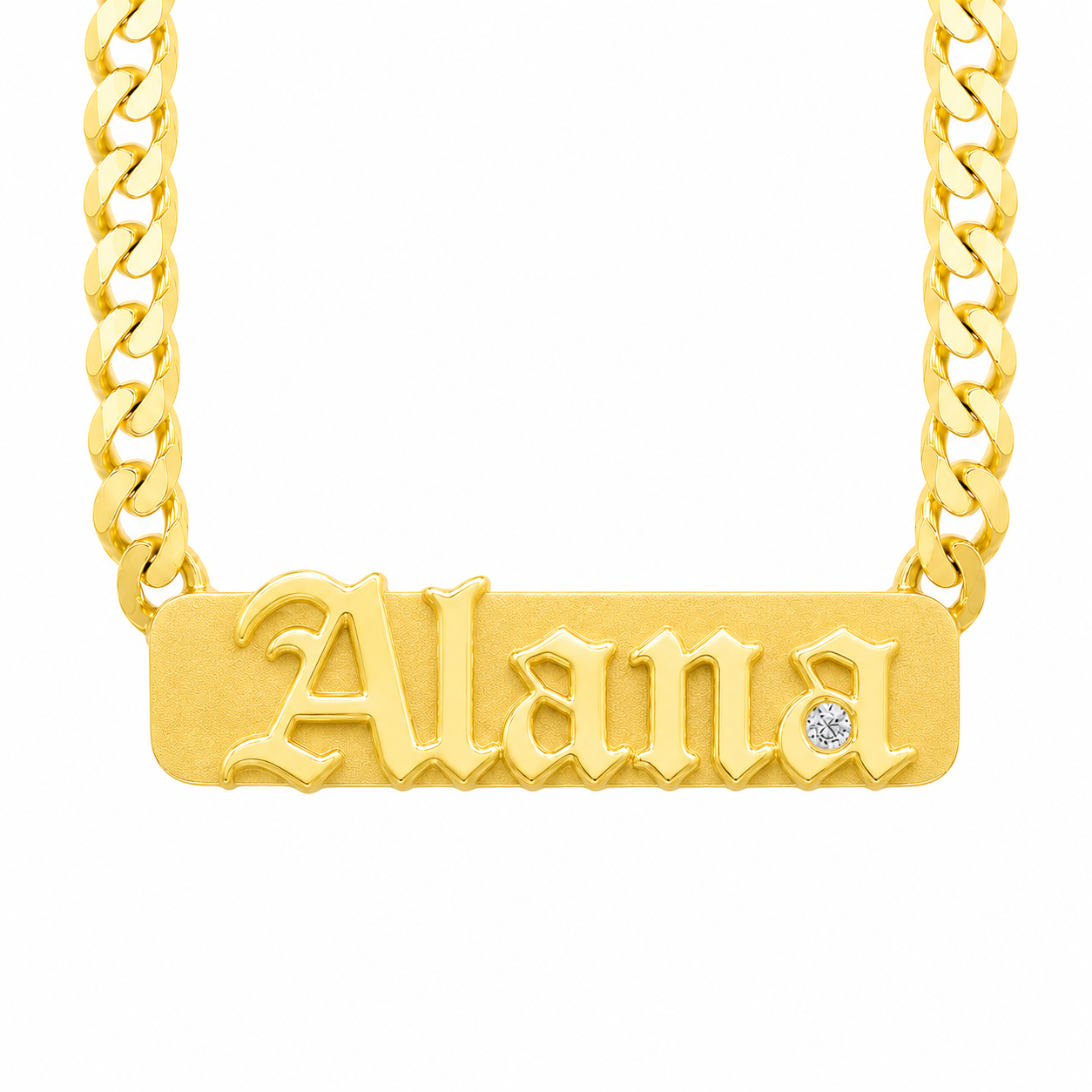
Our Best-Selling Nameplate Necklace, now in a modern Hawaiian heritage style lettering.
💛 18k gold pendant, approx 1 inch ⛓ 2.9 mm curb chain, 14K gold chain. 16" total with bar. (For 5+ Characters, bar may be slightly longer.)
💎 0.03 carat round diamond 🎬 Video
Each piece is made to order and ships within two weeks to four weeks.
TL;DR
Hawaiian heirloom jewelry isn't just a style, it's a specific, traceable tradition: a Victorian mourning custom, reinterpreted by a future queen, carried forward for over a century through one font and two motifs. Wearing it — traditional or modern — means wearing a small piece of that history.

